
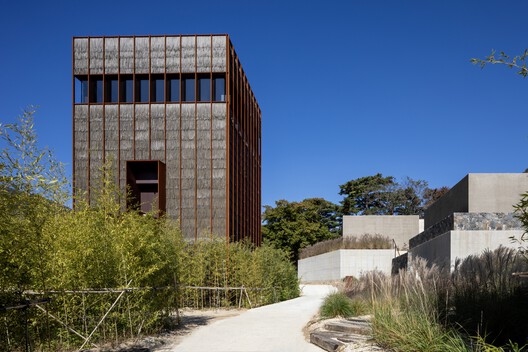
In an era obsessed with digital escapism and the relentless pursuit of novel user experiences, the architectural philosophy embodied by Mugok, as conceptualized by 100A associates, offers a profoundly counter-intuitive yet deeply resonant paradigm. It’s not about temporary retreat or dazzling display; instead, Mugok proposes an architecture that subtly guides individuals to reclaim a "renewed attitude within the everyday." For the tech industry, this isn't just a design principle for physical spaces; it's a potent manifesto for how we might conceive and construct our digital environments and tools, prioritizing human well-being over digital distraction.
Beyond Escapism: The Architecture of Re-engagement
Modern technology often serves as a portal to alternative realities, a constant stream of notifications and curated experiences designed to pull us away from our immediate surroundings. Mugok explicitly rejects this. "Mugok is not a place that invites escape... Rather, it is an architecture that guides one to recover a renewed attitude within the everyday." This distinction is critical. Imagine software that doesn't demand attention with endless feeds, but discreetly empowers deeper engagement with real-world tasks and relationships. This shift from escape to re-engagement challenges today's attention economy, advocating for tools that foster presence, not distraction.
The Subtlety of Presence: Technology as Background
The core tenet, "architecture does not dominate the subject—the user, the human—but instead settles quietly as a background for being," is a powerful articulation of ideal human-computer interaction. In a world of omnipresent screens and demanding interfaces, truly great technology often recedes, becoming almost invisible. It functions seamlessly, anticipating needs without being intrusive, supporting our activities rather than dictating them. This is the holy grail of ambient computing and intelligent systems: technology that is there when needed, allowing the user to remain the primary focus of their own existence.
Invisible Interfaces and Ambient Computing
Consider this philosophy in interface design. Instead of cluttered dashboards, Mugok inspires minimalist, intuitive, and context-aware interfaces. Smart home systems should ideally operate in the background, adjusting environments based on learned preferences without constant manual input. Wearables could provide vital information subtly, enhancing situational awareness rather than creating a secondary digital world to manage. Technology becomes an extension of our capabilities, not a separate entity vying for our consciousness.
The Power of Restraint: Resonance Through Simplicity
"Space is constructed through a language of restraint rather than display, and it is precisely this restraint that gives rise to a profound inner resonance." This principle directly confronts the tech industry's often overwhelming pursuit of feature bloat, flashy animations, and superficial novelty. The "language of restraint" in tech translates to elegant simplicity and a focus on core utility. When a product or service is stripped of unnecessary complexity, its essential purpose shines through, allowing users to connect with its fundamental value on a deeper, more meaningful level. This isn't just about aesthetics; it's about reducing cognitive load and fostering clarity.
From Feature Bloat to Meaningful Interaction
Many applications suffer from an overload of features, leading to confusion and user fatigue. Adopting Mugok's ethos means prioritizing intentional design, where every element serves a clear purpose, and the absence of clutter allows for a more focused interaction. Think of specialized tools doing one thing exceptionally well, or communication platforms prioritizing clear exchange over endless emoji reactions. The 'profound inner resonance' comes from the user feeling empowered and understood, rather than overwhelmed by choice or spectacle.
Reclaiming the Center: The Human in the Loop
Ultimately, Mugok's design culminates in the user regaining their center and re-establishing a relationship with the world. This is perhaps the most profound implication for technology. In an age where digital addiction and constant connectivity often lead to fragmentation, technology designed with Mugok's principles could actively help us anchor ourselves. By reducing digital noise and empowering mindful engagement, such technology could serve as a catalyst for deeper self-awareness, stronger real-world connections, and a more integrated, present existence. It proposes a future where technology doesn't just serve our tasks, but truly serves our humanity.
🚀 Tech Discussion:
The Mugok philosophy challenges us to rethink the very purpose of technology – from a means of escape or display to a quiet enabler of deeper human presence and connection with the everyday. Its principles offer a potent antidote to digital fatigue and a roadmap for truly humane technology, urging us to design for 'being' rather than 'consuming'.
Generated by TechPulse AI Engine