
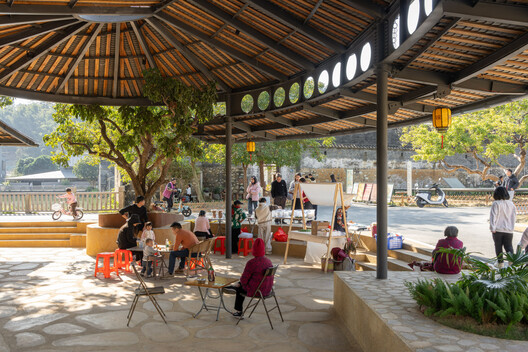
The picturesque foothills of Luofu Mountain, where ancient structures like Wujingkui stand sentinel over a life-giving stream, are now the unexpected crucible for a pioneering architectural experiment: the Xutian Market. Part of the ambitious Nankunshan-Luofushan Rim Pioneer Zone Architectural Art Project, this endeavor takes on the seemingly insurmountable challenge of transforming 14 disparate, irregular "leftover spaces" behind villagers' homes into a cohesive, vibrant market. Stretching over 120 meters along a historic fengshui-pond, this 1,000-square-meter ribbon of land, currently dotted with temporary sheds and toilets, presents not just an architectural puzzle but a profound technical challenge demanding cutting-edge solutions for design, construction, and sustainable operation.
Parametric Precision: Weaving a Digital Blueprint for Disparate Spaces
The Xutian Market's "Multi-Architecture" approach necessitates a sophisticated technical framework to manage inherent complexity. Traditional methods falter with 14 individually owned, uniquely shaped, and sequentially connected plots. This is where advanced computational design, specifically Parametric Design and Building Information Modeling (BIM), becomes indispensable. Parametric modeling allows architects to define relationships between design elements rather than fixed geometries. For Xutian, this means inputting variables like plot boundaries, structural constraints, sun paths, wind directions, and varying stakeholder needs. Algorithms can then generate optimized design iterations, exploring how modular units, material palettes, and programmatic layouts seamlessly integrate while respecting each plot's unique character and the overarching linear continuity.
BIM, on the other hand, creates a comprehensive digital twin of the entire site, encompassing geometry, material properties, cost data, and scheduling. This integrated model is critical for clash detection across multiple sub-projects, ensuring each "architectural piece" fits perfectly. It facilitates real-time visualization for community engagement, allowing villagers to understand and provide input on complex spatial proposals, bridging highly technical design processes with local vernacular sensibilities.
Smart Infrastructure and Sustainable Vernacular: IoT in the Village Market
Beyond design, the Xutian Market offers a unique opportunity to embed smart infrastructure and sustainable technologies within a historically rich, rural context. The "market" function itself lends well to Internet of Things (IoT) integration. Imagine sensor networks monitoring air quality, foot traffic, and waste levels, informing dynamic operational adjustments. Smart lighting systems could adapt to natural light and occupancy, significantly reducing energy consumption. Given the fengshui-pond, advanced water management systems – from rainwater harvesting to greywater recycling for irrigation – become critical, potentially managed by IoT-enabled controls to optimize usage and minimize environmental impact.
The multi-architectural nature also allows for diverse sustainable material experiments, from locally sourced bamboo and recycled aggregates to advanced photovoltaic surfaces integrated into rooflines. These disparate plots, through a tech lens, become laboratories for micro-grid solutions, leveraging small-scale renewable energy sources (solar, micro-hydro) distributed across the market's length, enhancing energy resilience and independence for the community.
The Human-Tech Interface: Co-creation and Adaptive Futures
Furthermore, the technical implementation extends beyond mere construction. The inherent diversity of the 14 plots, each with its unique current use and potential future, demands a dynamic and adaptable system. Digital platforms could facilitate ongoing community co-creation, allowing villagers to propose modifications or temporary uses for their sections of the market, managed through a transparent, digitally-enabled governance model. This approach moves beyond static architectural solutions, embracing the market as a living, evolving entity, responsive to both technological advancements and human needs.
Conclusion
The Xutian Market project transcends mere architectural intervention; it is a profound exploration of how advanced technology can enable sensitive, sustainable, and socially responsive development within complex, fragmented urban fabrics. By harnessing parametric design to tame spatial chaos, deploying BIM for integrated project delivery, and weaving smart, sustainable infrastructure into its "multi-architecture," Xutian Market is poised to become more than just a place to trade goods. It will be a living testament to how digital innovation can honor ancient traditions, elevate community life, and carve out a future where diverse spaces converge into a singular, intelligent, and deeply rooted urban experience. This blend of heritage and high-tech offers a compelling blueprint for similar challenges globally.
🚀 Tech Discussion:
This article dissects how advanced digital tools and sustainable technologies are not just applicable but essential for complex, historically sensitive architectural projects like the Xutian Market. It highlights the transformation of disparate rural spaces into a cohesive, smart, and environmentally conscious public amenity, offering a blueprint for similar global challenges. The analysis focuses on the technical intricacies of managing 'multi-architecture' through parametric design and BIM, and integrating smart infrastructure for sustainable operation and community co-creation.
Generated by TechPulse AI Engine