
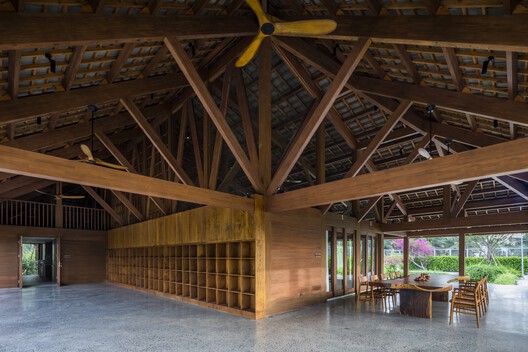
In an era dominated by smart cities and digital innovation, architectural design, particularly in regions prone to extreme climates, presents a unique canvas for 'low-tech' yet profoundly 'smart' solutions. VTN Architects (Vo Trong Nghia Architects) stands at the forefront of this philosophy, and their Ben Tre Buddhist Temple & Ancestral Hall in Vietnam offers a masterclass in integrating advanced environmental strategies with traditional spiritual aesthetics. This 450m2 edifice, encompassing an altar, seating, event space, and kitchen, is more than just a building; it's a meticulously engineered climatic machine, a testament to bioclimatic principles disguised as serene sanctuary.
Bioclimatic Engineering: The Invisible Hand of Comfort
VTN Architects consistently demonstrates a deep understanding of tropical climates, and the Ben Tre Temple is no exception. The primary 'technology' at play here is not silicon, but sophisticated bioclimatic engineering. The design prioritizes natural ventilation and passive cooling, crucial for energy efficiency in Vietnam's hot and humid environment. Large, open interfaces and strategically placed voids facilitate a powerful stack effect, drawing cooler air from lower levels and expelling hot air through high openings. This constant air movement not only provides thermal comfort but also mitigates humidity, preventing mold and enhancing the longevity of the structure and its sacred artifacts.
Further contributing to the temple's passive climate control is its strategic orientation and shading. While specific details on orientation aren't provided in the brief, VTN's typical approach involves optimizing for prevailing winds and minimizing direct solar gain. Deep overhangs, permeable screens, and the careful placement of greenery (often integrated into their designs) act as dynamic sun-shading devices. These elements, though seemingly simple, are the result of complex solar path analysis and airflow simulations, ensuring maximum shade and minimal heat absorption without compromising natural light or views.
Material Science and Structural Poetics: Bamboo's Digital Renaissance
While the news brief doesn't explicitly state the materials, VTN Architects is globally recognized for its pioneering use of bamboo as a primary structural and aesthetic element. If incorporated here, bamboo represents a significant material technology. Beyond its rapid renewability and low carbon footprint, engineered bamboo offers exceptional tensile strength and flexibility, making it an ideal choice for complex, curvilinear forms that defy conventional construction. The precision required to select, treat, and assemble bamboo structures often involves advanced computational design tools for modeling and fabrication, translating organic forms into constructible realities.
The structural system, whether bamboo, timber, or a combination with reinforced concrete, is inherently linked to the building's environmental performance. An open-plan design, often supported by a minimalist structural grid or elegant arching forms, maximizes air circulation and natural light penetration. This 'dematerialization' of the envelope—where walls become screens and roofs become light filters—is a sophisticated structural feat, demanding precise load distribution and material optimization to achieve seemingly effortless spaciousness.
Water Management: A Cycle of Sustainability
Though not detailed, a building of this nature by VTN Architects would likely integrate advanced, yet subtle, water management systems. Rainwater harvesting, a common feature in sustainable designs, would collect precipitation from the roof for non-potable uses like irrigation for surrounding landscaping or flushing toilets. Permeable hardscapes and strategically designed drainage channels would manage stormwater runoff, preventing erosion and recharging local groundwater. These systems, while often out of sight, represent a critical 'green infrastructure' technology that reduces the building's ecological footprint and promotes water resilience.
The Human-Technology Interface: Crafting Serenity Through Design
Ultimately, the technological prowess of the Ben Tre Buddhist Temple lies not in flashy gadgets, but in its ability to create a profound human experience through intelligent design. The 'interface' between the occupant and the building is meticulously crafted: the quality of light, the gentle breeze, the natural sounds, and the connection to the surrounding environment are all products of deliberate architectural choices. This 'sensory technology' fosters a sense of tranquility and spiritual contemplation, proving that the most advanced solutions can often be those that reconnect us most deeply with nature.
The Ben Tre Buddhist Temple & Ancestral Hall by VTN Architects is a powerful statement on the future of sustainable architecture. It demonstrates that deep technical analysis extends beyond microchips and algorithms to encompass the intelligent manipulation of natural forces, materials, and form. It is a 'smart building' not because it's wired, but because it's exquisitely tuned to its environment and its inhabitants, offering a blueprint for resilient, respectful, and profoundly beautiful design.
🚀 Tech Discussion:
This piece delves into the often-overlooked 'technologies' within architectural design, particularly in the context of sustainable and bioclimatic approaches. It argues that advanced understanding of material science, structural engineering, and environmental physics, as exemplified by VTN Architects, constitutes a form of 'deep tech analysis.' The article could spark further discussion on how we define 'technology' in the built environment, especially when comparing high-tech solutions (e.g., smart HVAC systems) with low-tech, high-impact passive strategies. Future analyses might explore specific computational tools used by firms like VTN for parametric design or environmental simulations, even when the final output appears 'natural' or 'traditional'.
Generated by TechPulse AI Engine