
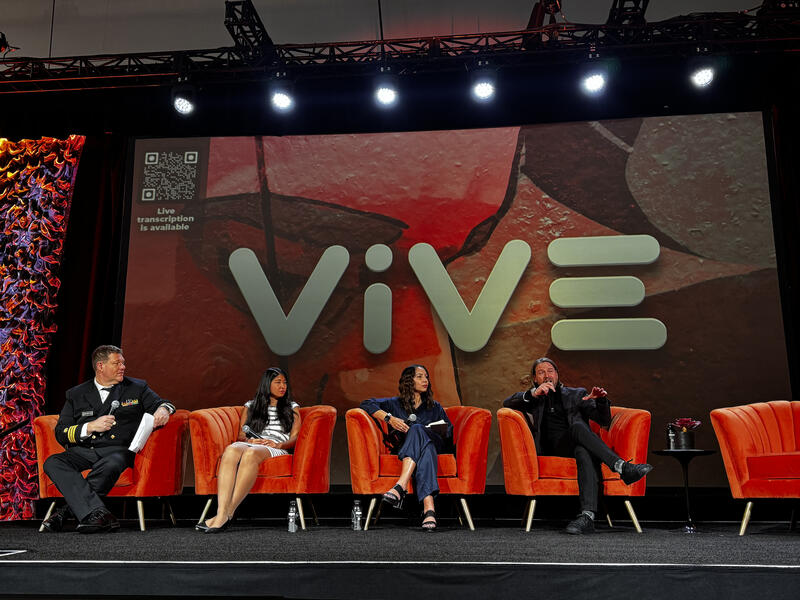
Alright, another week, another tech conference. You know the drill. Buzzwords flying, keynotes promising the moon, and us tech writers trying to decipher if it's genuinely groundbreaking or just a shiny new coat of paint on an old idea. This time, it’s the ViVE conference, and Sanford Health stepped onto the stage, touting 'rural innovation' and an 'AI-powered future of care.' And, honestly, my ears perked up a bit. Rural innovation? AI in healthcare? That's a potent mix, potentially transformative, or, you know, just more hot air.
It's easy to get cynical, I admit. I’ve seen enough 'future of healthcare' presentations to last a lifetime. But the rural angle here, that's what caught my attention. Because while we're all busy complaining about our smart devices not understanding us, there are vast swathes of the country (and the world, for that matter) where getting *any* healthcare isn't a matter of convenience, but a matter of geography, infrastructure, and sheer luck. We're talking about communities where the nearest specialist might be a three-hour drive away, where broadband is a luxury, and where the local clinic is often stretched thinner than my last nerve before a deadline.
The Rural Healthcare Conundrum: A Problem AI Might Actually Help Solve
Let's be real: rural healthcare is in crisis. Doctors are aging out, young practitioners gravitate to urban centers, and resources are scarce. This isn't just about 'access' in a theoretical sense; it's about life and death. Chronic conditions go undiagnosed, preventative care is often non-existent, and emergencies become critical faster. So, when Sanford Health talks about rural innovation, they're not just talking about incremental improvements. They're talking about fundamental shifts.
What kind of shifts? Think about it. Telehealth has been a lifeline, especially during the pandemic, but it's just the tip of the iceberg. True rural innovation needs to address the foundational issues. It needs to bring advanced diagnostics closer to home, make specialists virtually present, and empower local practitioners with tools they simply couldn't afford or manage before. And this is where AI theoretically struts onto the scene.
AI's Role: Beyond the Robot Doctor
When people hear 'AI in healthcare,' their minds often jump to sci-fi scenarios: robot surgeons, sentient medical assistants. And while those things might be decades away, the immediate, practical applications of AI are far less dramatic but far more impactful. Sanford Health, I imagine, isn't talking about replacing doctors with bots. They're talking about augmenting them.
Imagine an AI system that can sift through vast amounts of medical literature and patient data to assist a rural general practitioner in diagnosing a rare condition. Or perhaps an AI-powered tool that analyzes medical images – X-rays, MRIs – flagging potential issues for a radiologist who might be hundreds of miles away, speeding up review times. That's not replacing the human, it's giving them superpowers. It’s about leveraging data, pattern recognition, and predictive analytics to make healthcare delivery more efficient, more accurate, and critically, more *accessible* in underserved areas.
I recall a conversation I had with a physician once, practicing in a small town in North Dakota. He told me about how he often felt isolated, making critical decisions without the immediate backup of a specialist team you'd find in a city hospital. The sheer mental load. If AI could, say, help prioritize patient queues, suggest potential drug interactions based on a patient's entire history, or even just automate some of the mind-numbing administrative tasks – that's a huge win. It frees up the human element to focus on what humans do best: empathy, complex problem-solving, and direct patient interaction.
Actually, that's not quite right – let me explain. While some AI can help with diagnostics, the real immediate game-changer for rural areas might be in logistics and resource allocation. Predictive analytics could forecast outbreaks, optimize staffing, or even manage medical supply chains more effectively. Think about how many rural hospitals struggle with operational efficiency. AI could be a silent, powerful backend partner, making everything run smoother, thereby stretching scarce resources further. That's a massive deal for communities constantly battling closure threats for their local hospitals.
The Double-Edged Scalpel: Challenges and Ethical Headaches
Of course, it’s not all sunshine and perfect algorithms. This 'AI-powered future' comes with its own set of very real challenges. The biggest one for rural areas? Infrastructure. You can have the smartest AI in the world, but if there's no reliable broadband connection to transmit data, or if the local clinic can't afford the necessary hardware, it's effectively useless. The digital divide isn't just a quaint term; it's a gaping chasm.
Then there's the ethical minefield. AI models are only as good as the data they're trained on. If that data is biased – and let's be honest, historical medical data often reflects systemic biases – then the AI could perpetuate or even amplify those disparities. We're talking about diagnostic tools that might perform less accurately for certain demographics, or predictive models that inadvertently disadvantage specific patient groups. That's not just a bug; that's a serious ethical crisis waiting to happen.
And privacy. Oh, privacy. Healthcare data is perhaps the most sensitive data there is. How do we ensure that vast amounts of patient information, processed by AI, remain secure? Who has access? Who is accountable when an AI makes a mistake? These aren't minor details; they're foundational questions that need robust answers before widespread adoption can truly take off.
Plus, let's not forget the human element. Healthcare is deeply personal. Will patients in rural communities, often with deeply ingrained traditions and trust in their local doctor, embrace AI-driven solutions? There's a learning curve, a trust curve, and a 'this isn't how we've always done it' curve that needs careful navigation. You can't just drop advanced tech into a community and expect instant adoption. It requires education, engagement, and a deep understanding of local needs and concerns. It requires the human touch, ironically, to implement AI effectively.
My Take: A Glimmer of Hope, But No Easy Answers
So, where does that leave us? Sanford Health's spotlight on rural innovation at ViVE is incredibly important. It draws attention to a critical, often overlooked sector of healthcare. The potential for AI to bridge gaps, enhance capabilities, and ultimately save lives in underserved areas is enormous. It's truly exciting, genuinely. But it's also fraught with complexity.
It's not just about building the tech; it's about building the *ecosystem* around the tech. The infrastructure, the ethical frameworks, the trust, the training. It's about ensuring that these powerful tools don't just widen the gap between the tech-rich and the tech-poor, but actually serve as an equalizer. We need to focus on equitable access, not just innovation for its own sake. Because the future of care, AI-powered or otherwise, needs to be for *everyone*, especially those who need it most.
🚀 Tech Discussion:
Considering the immense challenges of rural healthcare, how do you think we balance the exciting potential of AI with the very real concerns around infrastructure, bias, and the essential human connection in care? Is it even possible to truly bridge the digital divide in health, or will some communities always be left behind?
Generated by TechPulse AI Engine