
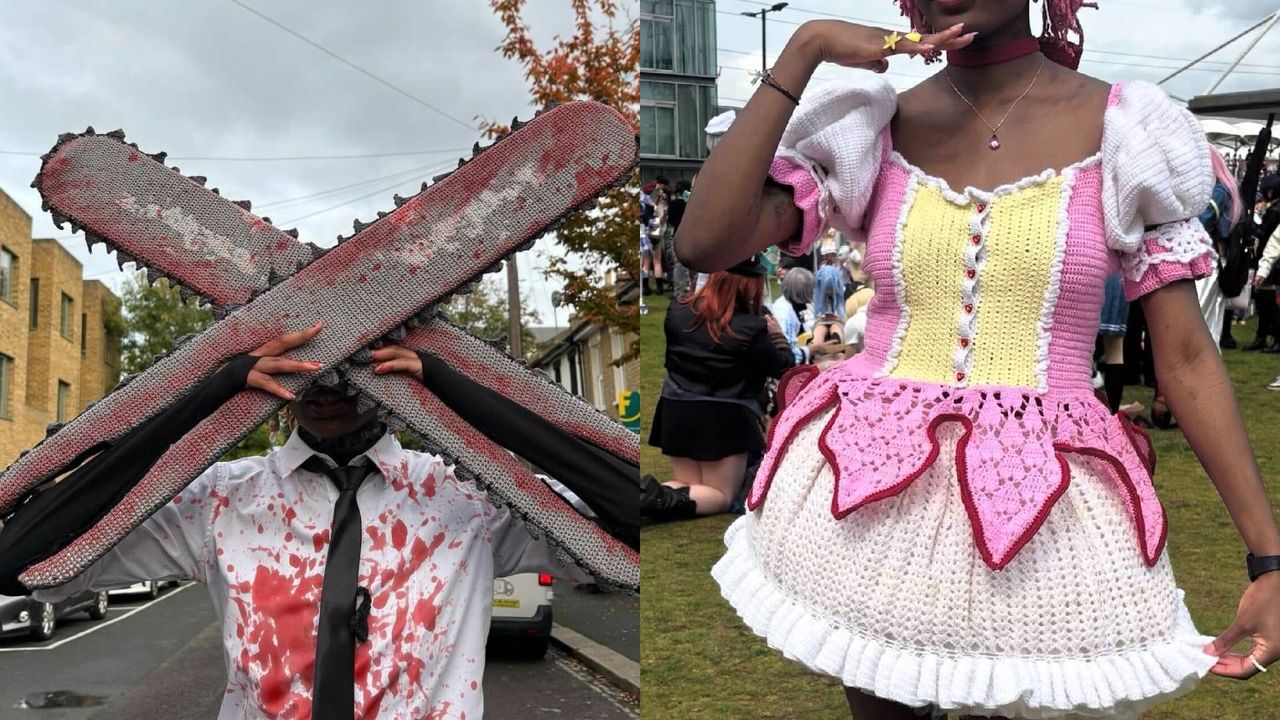
Alright, so I just read this news bite about a cosplayer absolutely *dominating* the needlework game, turning crochet into entire, jaw-dropping outfits. And, uh, my first thought? A profound sense of inadequacy. Not in a bad way, mind you. More like, a resigned admiration. Because the best I’ve ever managed with a hook and some yarn is, as the news so aptly put it, a fuzzy shrimp. A valiant effort, I assure you. Very fuzzy. But definitely not an Iron Man suit, you know?
It gets you thinking, though, doesn’t it? We talk about tech all the time – AI, blockchain, quantum computing, all that jazz. Big, abstract, often digital things. But then something like this comes along, this incredible, tangible, painstakingly crafted thing, and it makes you pause. Is this… tech? Can something as ancient and seemingly simple as crochet actually be, well, *advanced technology*?
The Unsung Engineering of Yarn and Hook
Initially, my tired brain would probably just shrug and say, “Nah, that’s craft. Art, even. But tech? Not really.” But then the curiosity kicks in. And honestly, the more I chew on it, the more I realize that my initial dismissal is just plain wrong. This *is* tech. Just not the kind we usually slap a 'disruptive' label on.
Think about it for a sec. What is technology, at its core? It’s the application of scientific knowledge for practical purposes. It’s tools, techniques, processes. It’s problem-solving. And when you look at these cosplay outfits – not just a scarf, but an *entire wearable structure* – you’re seeing an incredible feat of engineering. With yarn.
Consider the 'algorithm' of it all. Every stitch, every row, every increase or decrease, follows a precise, repeatable pattern. That’s code, essentially. A sequence of instructions that, when executed correctly, builds a specific structure. You’re not just randomly looping yarn; you’re designing, calculating, and executing a complex, three-dimensional blueprint. For something like a helmet or a gauntlet, you’re dealing with structural integrity. How does it hold its shape? How does it fit the human form? What kind of yarn (material science!) provides the necessary rigidity or drape? These aren’t trivial questions. These are design challenges.
Actually, that’s not quite right – it’s more than just design. It’s iterative development. You crochet a piece, you try it on, you realize it’s a bit too snug here, too baggy there. What do you do? You 'frog' it – unravel it, sometimes hours of work – and start again, adjusting your 'code.' That’s debugging. That’s agile methodology, in thread form. If a software engineer did that, we’d call them brilliant. A crocheter does it, and we just call it a hobby. Hmm. Food for thought.
Digital Threads in a Tangible World
And let’s not forget the digital side of this. This cosplayer isn't living in a vacuum. They’re likely pulling inspiration from digital concept art, sharing their progress on Instagram or TikTok, maybe even selling patterns on Etsy. The *entire ecosystem* around modern craft is deeply intertwined with digital technology. YouTube tutorials break down complex stitches, online forums offer troubleshooting, and 3D modeling software might even be used to visualize a complex shape before a single loop is made.
I remember trying to learn to knit once. Emphasis on 'trying.' The patterns looked like hieroglyphics. But then I found a video tutorial, slowed it down, watched it fifty times. That digital bridge, that ability to *see* the technique, was a game-changer. It’s still incredibly complex, still requires immense skill, but the barrier to entry is lowered by tech. And for someone creating entire outfits, the resources, the community, the sharing of innovation – it’s all amplified by the internet.
Cosplay itself is a fascinating blend of art and engineering. People use 3D printers, laser cutters, advanced textiles, microcontrollers for lighting effects. It’s a field where innovation is rampant, driven by passion. And when someone decides to tackle a complex character with crochet, they’re not just choosing a medium; they’re choosing a *toolset*, with its own unique constraints and possibilities. They’re pushing the boundaries of what that toolset can achieve. That’s innovation, plain and simple.
Implications: Redefining 'Tech' and Celebrating Human Ingenuity
So, what are the implications of looking at something like high-level crochet cosplay through a 'tech' lens? Well, for one, it broadens our understanding of what technology truly is. It reminds us that tech isn’t just about the newest gadget or the most complex algorithm running on a server farm. It’s also about human ingenuity, about mastering a craft, about the persistent, often painstaking, effort to create something new or to push an existing method to its limits.
It also highlights the value of 'slow tech' or 'artisanal tech.' In a world obsessed with speed and automation, there’s something deeply satisfying, even profound, about work that takes hundreds, if not thousands, of hours of human effort. It’s a counter-narrative to the idea that efficiency is the *only* metric of progress. Sometimes, the value is in the journey, in the skill developed, in the unique, unreplicable result. This kind of work – this human ingenuity – builds deep skill, incredible patience, and a mastery that automated processes simply can’t emulate.
Plus, it’s just inspiring, right? To see someone take something familiar, something often dismissed as 'just a hobby,' and elevate it to such a high art form. It makes you wonder what other 'low-tech' practices are actually hiding incredible complexity and innovative potential, just waiting for a passionate individual to unlock them. This human ingenuity, this dedication, it’s what drives all forms of progress, digital or otherwise. It's the same spark that builds a satellite and crochets a dragon.
Ultimately, this cosplayer with their incredible crochet outfits isn't just making costumes. They're making a statement. A statement about skill, about vision, and about the sheer, untamed power of human creativity. And maybe, just maybe, it’s a gentle reminder to us tech writers to look beyond the circuit boards and the code, to see the technology inherent in every act of creation. Even in a fuzzy shrimp, if you squint hard enough.
🚀 Tech Discussion:
Does this kind of intricate, skill-based craft challenge your own definition of 'technology'? Where do you draw the line, or should we even bother trying to?
Generated by TechPulse AI Engine