
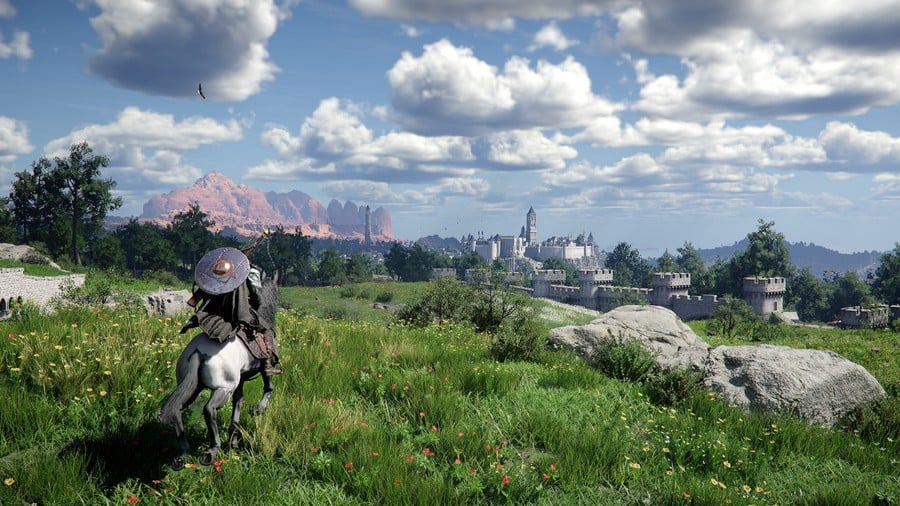
Alright, stop what you’re doing for a second. Did you happen to catch Digital Foundry’s recent deep dive into Crimson Desert? Because, *wow*. Just… wow. My jaw hit the floor, rolled under the desk, and is probably still trying to figure out what just happened. Pearl Abyss, the wizards behind this upcoming open-world adventure, seem to have pulled off some serious magic with their Dragon Engine on PC. But here’s the thing, and it’s a big thing: while the PC build looks absolutely sensational, it also leaves a whole lot of questions hanging in the air about the PlayStation 5 version, which is slated for release in a mere couple of weeks. A real head-scratcher, honestly.
The PC Dream: A Feast for the Eyes (and Graphics Cards)
Let's talk about the PC first, because that's where the immediate, undeniable impressiveness lies. Digital Foundry showcased Crimson Desert running on a high-end PC, and it's nothing short of breathtaking. We're talking about an open world that feels utterly alive. The sheer fidelity is bonkers. Character models? Insanely detailed, with dynamic hair physics, realistic skin shaders, and clothing that reacts to movement and environment with a level of nuance usually reserved for pre-rendered cinematics. It's just… *there*, in real-time gameplay.
The environmental detail is another beast entirely. Forests are dense, with individual leaves swaying, shadows dappling the ground in a way that feels organic, not just some procedural trick. Textures are sharp, from rough rock faces to shimmering puddles. And the lighting – oh, the lighting! Global illumination makes every scene pop, dynamic time-of-day cycles cast long, dramatic shadows, and particle effects from spells or environmental interactions look utterly phenomenal. You can practically *feel* the heat from a fire, or the chill of a frosty morning. Pearl Abyss has always been known for pushing visual boundaries (remember Black Desert Online?), but this feels like a significant leap, a new benchmark for open-world fidelity.
And it's not just pretty pictures. The physics system, from what DF showed, is incredibly robust. Environmental destruction, ragdolls, the way objects interact with the world – it all seems incredibly sophisticated. This isn't just about rendering power; it's about the underlying engine architecture, the Dragon Engine, doing some heavy lifting to create a truly dynamic and immersive world. They're clearly leveraging modern APIs and hardware to their absolute fullest on the PC side, and the results speak for themselves: smooth frame rates, crisp resolutions, and a level of graphical complexity that makes you stop and just admire it.
The Console Quandary: Where Does PS5 Fit In?
Now, here's where my tired tech-writer brain starts doing mental gymnastics. If this is the *PC* experience, what on earth does that mean for the PlayStation 5? The analysis, pointedly, focused almost entirely on the PC build. Which, you know, makes sense for a tech deep-dive showing off bleeding-edge visuals, but it also creates a vacuum of information about the console version. And that vacuum? It's filled with a lot of nervous energy and speculation.
The PS5 is a powerful console, absolutely. It's got a custom AMD RDNA 2 GPU, a zippy Zen 2 CPU, and that lightning-fast SSD that's supposed to revolutionize game loading and asset streaming. It’s a fantastic piece of hardware, capable of incredible things. We’ve seen it deliver stunning visuals in games like Horizon Forbidden West, Spider-Man 2, and God of War Ragnarök. But the gap between a high-end PC (we're talking RTX 4090 territory, potentially) and a fixed console spec, even a very good one, is substantial. It's just a fact of life in the gaming world.
So, when you see a PC version of Crimson Desert looking *this* good, with *this* much detail, *this* much physics, and *this* much draw distance, the immediate question that springs to mind is: what sacrifices will be made for the PS5? It's not a question of 'if', but 'how much'. Will it be a locked 30 frames per second, perhaps with a 'performance mode' targeting 60fps but with significant resolution or graphical quality reductions? Will the environmental density be drastically cut? Less detailed textures? Lower polygon counts for models? Simplified physics? Less impressive lighting? All of the above?
I mean, look at games like Cyberpunk 2077 at launch. While that was a much more extreme case of poor optimization and a rushed release, it highlights the challenges of scaling demanding open-world titles across different hardware. Even more recent, well-optimized games like Hogwarts Legacy or Starfield (on Xbox Series X, which shares a lot of architectural DNA with PS5) have shown clear trade-offs between visual fidelity and performance on consoles compared to their high-end PC counterparts. It’s just the nature of the beast, you know?
The Implications: Excitement, Expectations, and the 'Next-Gen' Divide
The implications here are pretty fascinating, and a little concerning. On one hand, it's incredibly exciting to see developers pushing hardware this hard. It shows what's possible, and it raises the bar for what we can expect from games in the future. For PC gamers with the rigs to handle it, Crimson Desert looks set to be an absolute showpiece. A technical marvel, a real benchmark.
On the other hand, it sets up a potentially tricky situation for console players. Pearl Abyss has chosen to unveil this incredibly polished PC version so close to the console launch. This immediately calibrates expectations to an extremely high level. If the PS5 version doesn't come *very* close to that visual standard, there's a real risk of disappointment. It could fuel the ongoing debate about the true meaning of 'next-gen' graphics and the inherent limitations of fixed-spec console hardware versus the ever-evolving PC landscape.
It also makes me wonder about the development process. Is the PC version the 'lead' platform, with console versions being scaled down from that? Or are they developed in parallel, with Pearl Abyss just choosing to highlight the ultimate potential of their engine? I lean towards the former, given the sheer flexibility and power of PC hardware. But whatever the reason, the contrast is stark. And the silence on the PS5's technical specifics feels… deliberate. Almost like they're letting the PC version build all the hype, before revealing the perhaps more modest console reality.
I'm genuinely thrilled for Crimson Desert. The world looks incredible, the combat seems engaging, and the sheer ambition is palpable. But this Digital Foundry analysis, while brilliant at showcasing the PC's prowess, has left me with a lingering, almost nagging, feeling. It’s like being shown a Michelin-star meal, and then being told your reservation is at a perfectly good, but definitely not *that* good, family restaurant. It makes me wonder, it really does. It makes me wonder what the console experience will *actually* be like.
So, what do you all think? Are these performance gaps inevitable, or should console players expect parity, especially this deep into the console generation?
🚀 Tech Discussion:
After seeing the stunning PC build of Crimson Desert, are you more excited, or more concerned about how the PS5 version will stack up? What level of visual compromise do you expect for console releases of such demanding games?
Generated by TechPulse AI Engine