
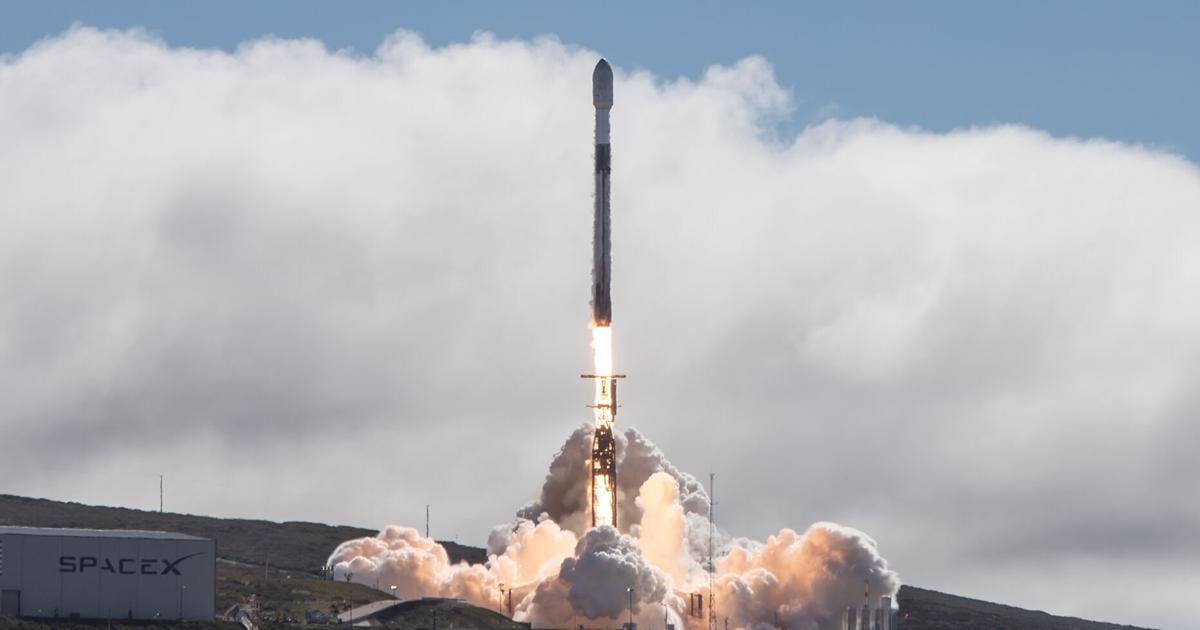
Seriously, another Starlink launch? Didn't they just do one last week? (Spoiler: yes, probably.) But here we are again, staring down the barrel of another SpaceX Falcon 9 rocket lifting off from Vandenberg Space Force Base, adding another 25 Starlink satellites to its ever-growing constellation. It's becoming so routine, you almost forget how utterly wild this all is, right?
Today's mission from Vandenberg is just another day at the office for Elon's rocketry gang. Twenty-five more pieces of high-tech hardware, destined for low-Earth orbit (LEO). And when I say 'low,' I mean low enough that you can sometimes spot these shiny little bastards streaking across the night sky, a phenomenon that has astronomers everywhere collectively groaning. But we’ll get to that. For now, let's just acknowledge the sheer, relentless cadence of these launches.
The Falcon and the Flood
The Falcon 9. What an absolute workhorse. It’s hard to overstate how much this single rocket has changed the space industry. Reusability. That’s the magic word. It's not just a fancy trick for viral videos of boosters landing vertically; it's fundamentally altered the economics of space access. Before Falcon 9, launching anything into orbit was prohibitively expensive, a one-and-done kind of deal. Now? It’s like a commercial airline flight, almost. Get up, drop off payload, come back down, refuel, repeat.
This particular launch, like so many before it, is all about Starlink. For those who somehow missed the memo (maybe you live under a rock, or, ironically, in a rural area with terrible internet), Starlink is SpaceX’s ambitious, some might say audacious, plan to blanket the entire globe with high-speed, low-latency internet. How? By putting thousands, eventually tens of thousands, of small satellites into LEO. And when I say thousands, I mean it. This isn't just a few dozen; we're talking about a literal swarm.
Why LEO, you ask? Good question. Unlike traditional geostationary satellites, which orbit much, much higher (like 36,000 km up) and appear stationary in the sky, LEO satellites are closer to Earth (around 550 km). This proximity drastically reduces latency – the time it takes for data to travel from your device to the satellite and back. Think about it: a shorter trip means faster pings, which means better video calls, snappier web browsing, and less infuriating lag when you’re trying to game online. Plus, you don't need gigantic, expensive dishes to connect. Though, the Starlink dish isn't exactly tiny, is it? More like a fancy, motorized pizza box.
The Good, The Bad, and The Shiny
So, what are the implications of all this Starlink activity? Let's start with the undeniably good stuff. The digital divide is real, folks. I’ve got friends who live just an hour outside a major city, and their internet options are dial-up or… well, nothing. Starlink changes that. Suddenly, remote communities, disaster zones, even ships at sea can get reliable, fast internet. That’s a massive win for connectivity, for education, for commerce. It's about empowering people who were previously left behind by terrestrial infrastructure. And that’s a genuinely exciting prospect. It really is, connecting the unconnected.
But, and you knew there was a 'but,' there are some significant downsides, too. The most vocal critics are, understandably, astronomers. Those thousands of Starlink satellites, especially shortly after launch, are incredibly reflective. They create streaks across astronomical images, effectively photobombing crucial scientific observations. Imagine trying to capture a faint galaxy light-years away, only to have a bright Starlink satellite mess up your shot. Every night. It's a legitimate concern, and while SpaceX has made efforts to mitigate this with darker coatings and sunshades (dubbed "DarkSat" and "VisorSat"), it's an ongoing battle.
Then there's the space junk problem. Every launch, every satellite, adds to the already congested LEO environment. What happens when these satellites reach the end of their lives? Starlink satellites are designed to de-orbit themselves, burning up in the atmosphere. That's the plan. But plans can go awry. A collision, even a minor one, could create thousands of pieces of new debris, each traveling at orbital velocities, posing a threat to other satellites, and even the International Space Station. We're talking about a potential Kessler Syndrome scenario, where a cascading series of collisions renders LEO unusable. It's not science fiction anymore; it's a real, tangible risk that grows with every single launch.
And let's not forget the geopolitical angle. Control over global internet infrastructure? That's powerful. Really, really powerful. Who decides who gets access? Who monitors the data? These are complex questions that haven't been fully addressed yet, and Starlink's dominance in this new space (pun intended) certainly raises eyebrows.
Looking Up, Looking Ahead
So, as another 25 Starlink satellites arc into orbit from Vandenberg, it's not just another launch. It's another step in a grand, global experiment. An experiment in connecting humanity, yes, but also an experiment in managing our shared orbital commons. The sheer scale of it is mind-boggling, almost dystopian in its relentless efficiency. It makes you wonder how much more we can pack into LEO before something gives.
I mean, I appreciate good internet as much as the next person, probably more given my line of work. But at what cost? Is the convenience of seamless global connectivity worth the potential impact on scientific discovery, the risk of polluting our orbital backyard, and the complex ethical questions of who controls the internet from above?
🚀 Tech Discussion:
What's your take? Is the global connectivity Starlink offers worth the potential downsides like light pollution and space junk? Or is this just the inevitable march of progress?
Generated by TechPulse AI Engine